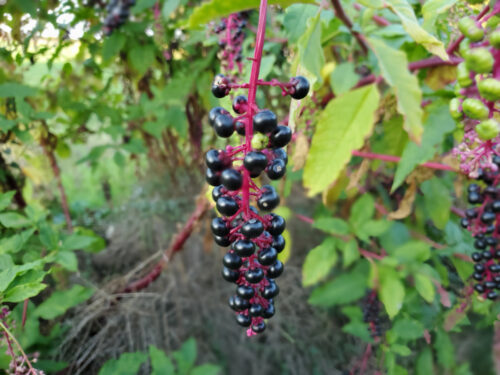
Common pokeweed (Phytolacca decandra) is a native plant that can be quite impressive with its towering growth habit and clusters of deep purple berries. We typically want to encourage natives in our landscape for their ease of care and the many benefits they provide to pollinators and wildlife. Still, experts say it might be best to approach pokeweed with a bit of caution – as you would poison ivy – another native plant that is beneficial to birds, but harmful to humans. So what are the drawbacks to pokeweed?
According to the University of Illinois Extension, pokeweed is native to much of the United States. It is a herbaceous perennial that can grow very tall, reaching six to 10 feet or even higher.
Leaves are simple and alternately arranged on smooth, reddish-pink stems. Leaves can also be very large – between four and seven inches. Pokeweed produces white or pink flowers in mid-summer on reddish-stemmed racemes (flower clusters). The berries that form are green at first and then turn a deep purple to almost black when mature. The berries are an important food source for birds, including northern cardinals, cedar waxwings, pigeons, and mourning doves. These birds help disperse the seeds near their roosting sites.
As the common name indicates, pokeweed is considered a weed in garden beds and nurseries. If you allow seedlings to mature, the plant will take over as it grows in height and width. Illinois Extension says a single plant can produce 7,000 seeds each year, and those seeds can remain viable for decades. Pokeweed grows quickly, developing a long taproot in just five to nine weeks that can regrow in subsequent seasons.
Pokeweed is best removed while it is small, pulled by hand. Once the tap root develops, you may need to dig with a shovel to remove the root completely. Penn State Extension suggests cutting back larger plants several times each season until the energy stored in the taproot is used up. Herbicides such as glyphosate or broadleaf herbicides can be used, but follow instructions on the label. For a targeted approach, Penn State recommends cutting the plant near the ground and applying herbicide directly to the wound for the shortest route to the taproot.
Besides its large size, another reason for keeping pokeweed in check is that all parts of the plant are poisonous to humans. Illinois Extension says consuming the plant causes symptoms ranging from feeling ill to death in rare cases. The berries are especially toxic. This could be of special concern if you have young children or young children who visit your home. I remove pokeweed from garden beds, but allow it to grow along the edges of my rural property.
Despite being poisonous, pokeweed was used historically as a food, medicine, and dye. Illinois Extension explains that young stems and leaves were consumed, but cautions that the plant material must be properly prepared before consumption – this, however, is not recommended.