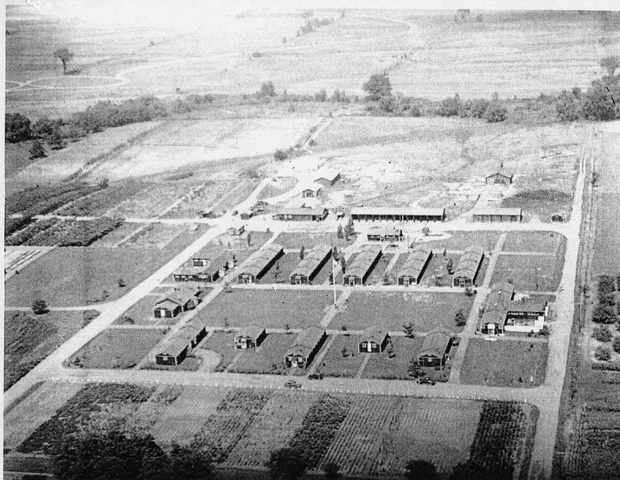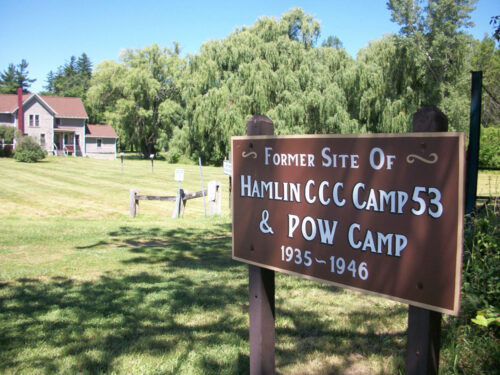
The Civilian Conservation Corps (CCC) Camp on Moscow Road in Hamlin opened in 1935, part of a New Deal initiative to provide manual labor jobs related to conservation to unemployed young men during the Great Depression. Enlistees earned $30 a month, of which they got to keep $5 while the rest was sent to their family. The young men were fed, clothed, and provided with educational and recreational opportunities that improved their health and boosted their self esteem.
Each camp was assigned a meaningful task to improve the nation’s infrastructure. The Moscow Road CCC camp was outfitted to house 200 enlistees and given the task of turning a small, plain county park into the Hamlin Beach State Park that we know today. The former campsite is located just east of the southern entrance to the park, adjacent to 968 Moscow Road.
CCC program enrollment declined and the camps closed as the US entered World War II. Hamlin’s camp was modified in 1944 to accommodate German prisoners of war. The first German POWs arrived in Hamlin on June 30, 1944. The prison population fluctuated with the seasonal labor demands of the local farmers and the area food processing plants. The Hamlin POW camp closed on January 11, 1946.
After that, the buildings disappeared, and nature took over the abandoned site. In 2008, Park Manager Marty Howden had the idea to turn the site into a history trail. Led by Ed Evans, volunteers from Hamlin and the surrounding area began working to clear more than 70 years of growth. Along the way, they found various artifacts and historical treasures. After six years of hard work, an interpretive trail explaining the history of the camp opened in 2014.
A historical marker will soon be installed at the site of the 1935-1946 Hamlin CCC/POW camp on Moscow Road. A new website devoted exclusively to the CCC/POW historic site will also be up and running in the near future. And two other existing websites will be adding new stories about the site.
Ed Evans has written a 50+ page “inside story” of the site’s unburying. Below, he shares the Epilog of that story. It highlights the importance of the site to those who lived there, the stories shared, and connections made along the way.
Epilog [Payback]
by Ed Evans
One day as I reported to work at the site, I spotted 89-year-old Hazel Lake wandering around the CCC camp with her daughter. She was carrying, folded in half, one of those long, narrow group photos taken when her husband-to-be, George, lived in the camp. George’s face was lost in the crinkled crease of the fold but she also had a winter snapshot of him standing alone in front of Barracks #1.
George Lake enjoyed his 1930s enlistment with the CCC in Hamlin but missed his girlfriend in Medina. Every weekend George walked 30 miles to Medina to be with her. Once in a while he got lucky and got a lift part of the way but he almost always arrived late back in the camp. Usually he got extra KP for the tardiness. George had passed away some time ago and Hazel was curious to have a look at the camp from which George walked all that way to see her.
I introduced myself to her and offered to show her where the photographer was standing when he took that long group photo. I pointed to the location in the Mess Hall where George probably did most of his extra KP duty and then I showed her where George’s barracks had stood. She made it around the entire site and asked lots of questions. Over the next couple of years, Hazel showed up with other members of her family for a repeat tour! She had the crease in the long photo professionally repaired and gave me a copy along with a family-complied collection of stories George had told them about the six months he spent in our camp.
Then I got a call from a lady in Kendall who heard about our project. She had a large paper bag of 100+ letters written to a guy in the Hamlin CCC camp and asked if I wanted them. I wasted no time getting to her house!
Cora Bissel had purchased the bag at a yard sale in front of a house that burned to the ground a month later. It contained the letters and a bunch of other stuff but none of what Cora had hoped to find in the bag. The letters were addressed to James Giancaterin, Barracks #5, Hamlin, New York. All his friends called him Jimmy G.
Jimmy G was from downtown Rochester and his father had just died in a workplace fire. Jimmy quit school at the end of his junior year and signed up for the CCC to help his mother (who spoke no English) support their family. He was bright, outgoing, and a good worker. He sang solo at weekly talent contests between the five barracks, worked for the camp’s weekly newspaper, and earned the nickname “Lady Killer.”
Unlike George Lake, but like a great many other CCC “graduates,” Jimmy G never shared his CCC experiences with any of his family. But it is obvious that he treasured every minute of his CCC experience! That paper bag he stashed in Kendall was stuffed with items secreted away to remind someone, someday, what a great experience his year-and-a-half in the CCC had been! Aside from the l33 letters there were two spiral-bound, pocket-sized diaries full of very neatly penciled-in entries. The bag also contained a stack of the newspapers the camp produced – all issues the Hamlin Historian did NOT have! And, 60 negatives of photos he took, his CCC enlistment paperwork, and other miscellaneous items!
In all of the CCC research I have done since our project began, I have never heard about anybody ever coming across a CCC diary. When a story about my find appeared in a local newspaper, someone recognized the Giancaterin name in it and sent a scan of the article, via email, to an ‘about to retire’ Rochester middle school teacher. That teacher was one of Jimmy G’s daughters and when she finally discovered the article on her computer monitor, she broke down in tears. Her father had long since passed away and she had absolutely nothing that he ever touched. And she knew nothing about his CCC experience. She immediately tried to contact me.
She and her husband came to my house and I showed her the contents of that paper bag. She agreed that it should be kept with the CCC site we had unburied, but I gave her a few items that her father had “touched.” A short time later, she put on a dinner at her house for her siblings and their spouses and I delivered one of my CCC presentations, slide-screen and all. They have all since visited the site and have attended some of my other presentations around this area. I even provided the entertainment for a Giancaterin family reunion in downtown Rochester. One granddaughter was inspired enough to make an A++ DVD about our camp for a college course she was taking!
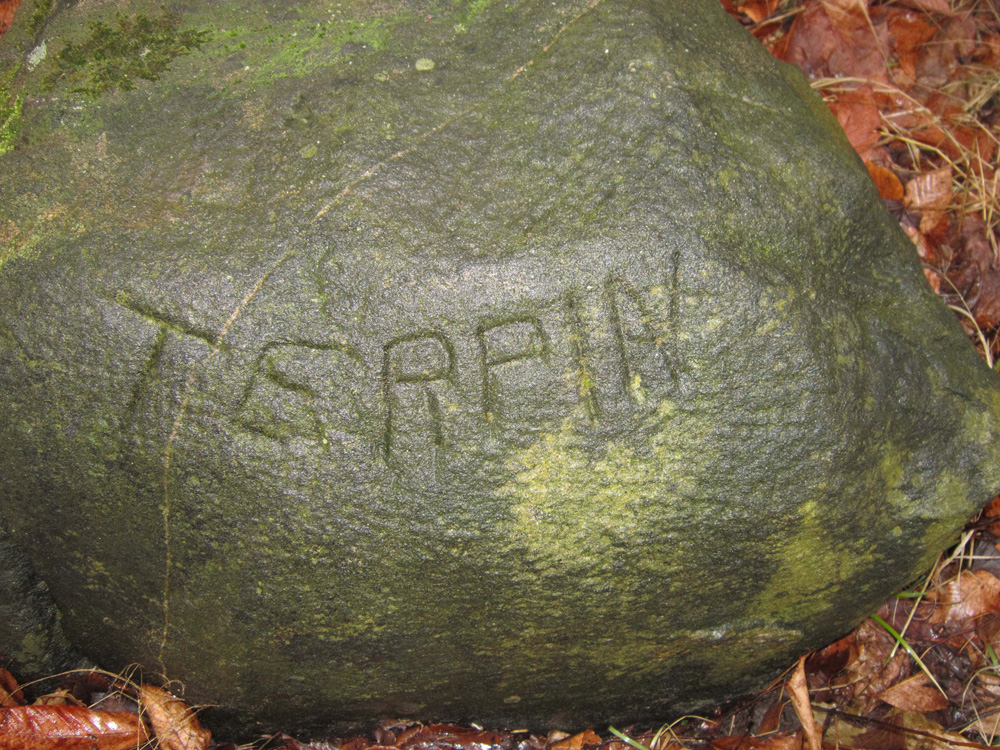
And then there was that large rock in the woods behind the new Hamlin Beach State Park Administration Building. Park Manager Jay Bailey wanted to know if it was an old grave marker of some kind or did it have something to do with the Park?
The rock had some chisel work done on it by a wanna-be (obvious amateur) stone cutter. The top was contoured somewhat like an antique metal tractor seat and “Terpin” in large letters had been chiseled on a rather rough face. Local lore said some ice age Indian sitting on the rock in a fit of rage put the dent in it, but Jay wasn’t buying that.
There were no “Terpins” in the Rochester area phone books but there was a “Terpin” listed as being in one of those long, narrow CCC group photos high on the wall in the Hamlin Historian’s museum. Jimmy G was also in that photo so I went through Jimmy G’s collection of CCC camp newspapers and found an article listing some “new inductees from Buffalo.” As luck would have it, one of those new inductees was a “Chester Terpin! “ I wrote a letter to the three Terpins in the Buffalo phone book and got an answer back. “Chester Terpin was my father!”
I invited the entire Chester Terpin family to Hamlin. They all sat on the rock for a photo-op and then we went to the unburied CCC site. Like Jimmy G, Chester never told anyone about his CCC experience and the Terpin family really enjoyed hearing about what went on in the camp as I gave them a tour. As we walked, little idiosyncrasies they had noticed in their father over the years suddenly explained themselves. The Army kitchen sized pies and artificial ice cream (a special Hamlin CCC recipe) he often cooked up, the tools he made from scratch, the house he built by himself, the tents he made, and the only Medina Sandstone barbeque in their part of town, all of a sudden made sense. When his youngest daughter learned about what went on in the CCC Education Building she shouted to everybody, “Now I get it! That’s how a man with a 6th grade education was able to help me with my algebra!”
As a teenager, Chester was “running the numbers” for mobsters in Buffalo and his mother was worried he might get shot. She forced him to sign up for the CCC. He was short, extremely shy and had terrible acne, which probably explained why he looked away when you spoke to him. Six weeks in the CCC camp and his acne went away! Probably because of the fresh air and improved diet. He signed up for every educational course he could, and learned about every skill his family gave him credit for in the CCC camp we just uncovered. After the CCC, he joined the military and was promoted to Sergeant – twice. As a family man, he spent his summers camping with his family but only in NYS camps that had been built by the CCC. He was in the process of doing that camping circuit again with his grandchildren when he passed away.
If the Hamlin CCC/POW camp had not been unburied, Hazel Lake’s family would never have bothered to collect George Lake’s CCC memories. If the camp had not been unburied Jimmy G’s contributions to our knowledge of the Hamlin history and American history that took place at 966 Moscow Road would never have come to light. And without Jimmy G’s paper bag we would have been stuck with the story of some Indian denting the rock behind the Park offices and Chester’s family would never know what made their father so unique.
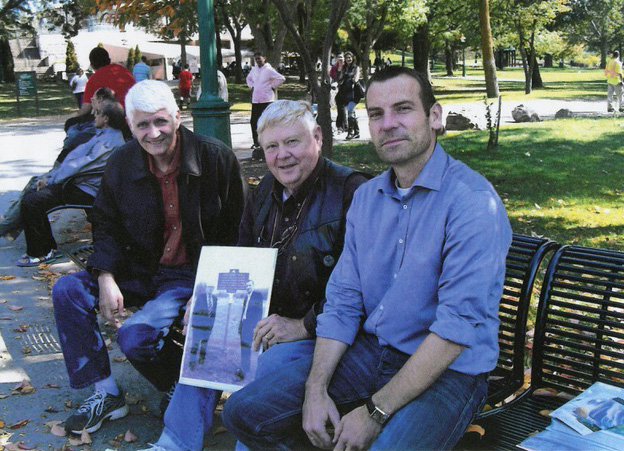
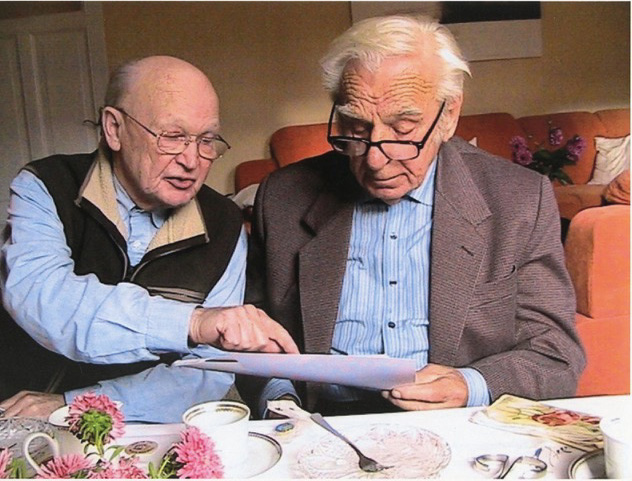
Over in Germany, two former German soldiers in their late 80s – who had survived WWII as POWs – lived 11 miles apart but were complete strangers. One at a time, I became pen pals with Heinrich Willert and Gottfried Schultze. Good things happened and Heinrich’s grandson and I were able to meet at Niagara Falls during the Hamlin unburying. Afterwards, Matthias Heinicke went back to Germany and arranged for the two WWII veterans to finally get to know each other. Another happy ending! If the Hamlin CCC/POW camp had not been unburied, Heinrich and Gottfried would never have learned that in 1944 they lived in the same barracks, at the same time, and their bunks were 50 feet apart – in the Hamlin POW camp! Thanks to the unburying, they were able to spend the last few years of their lives enjoying each other’s company, reliving the good times they enjoyed when they were “our guests” here in Hamlin.
[Research about German POW camps here in the United States is now being done at two new locations in Germany, prompted by the work done here on Moscow Road.]