On Thursday, July 24, the third annual Summer Reading Clinic wrapped up at Byron-Bergen Elementary School. For the past three years, graduate students from SUNY Geneseo have spent three weeks in July providing one-on-one or small group tutoring to elementary students as part of SUNY Geneseo’s Reading and Literacy Graduate Program. The clinic pairs graduate students, many of whom are working teachers, with elementary school-aged students. Together, they set literacy goals and develop strategies to achieve them. This year’s clinic included 14 participating graduate students and 30 elementary students.
“It’s exciting to see the clinic at capacity,” said Director of Instructional Services Betsy Brown. “Word has definitely spread through the community that this is a powerful program for reducing ‘summer slide’ and increasing literacy skills. It’s also a unique opportunity for many of these students to receive specialized attention specific to their literacy level.”
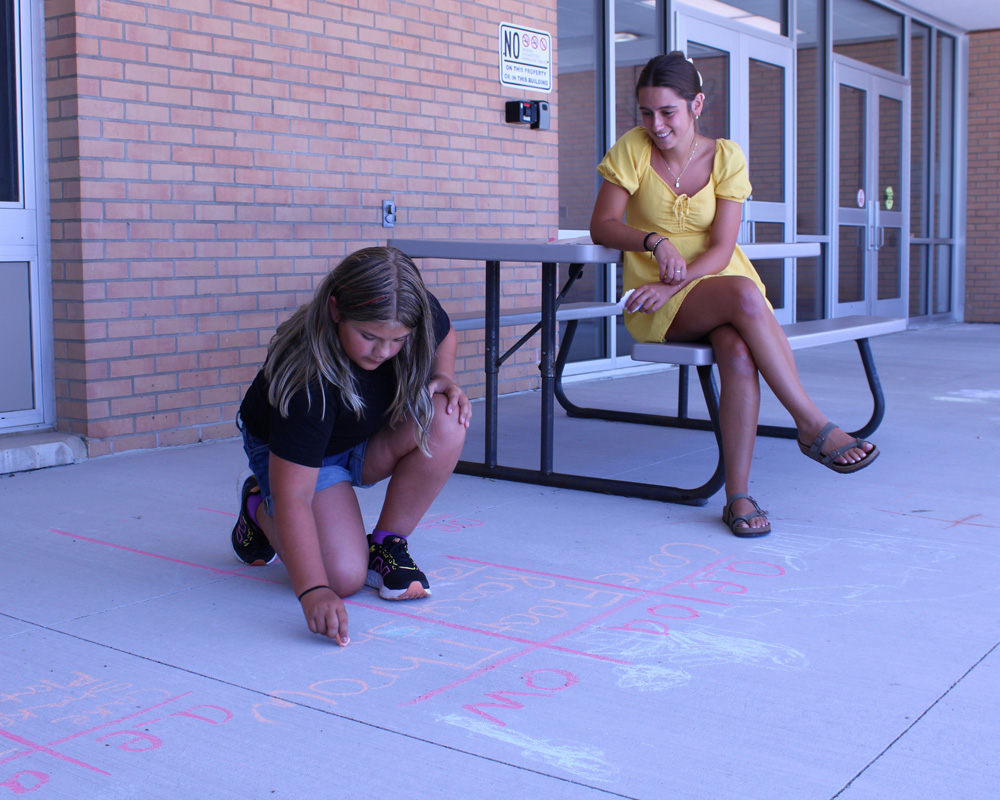
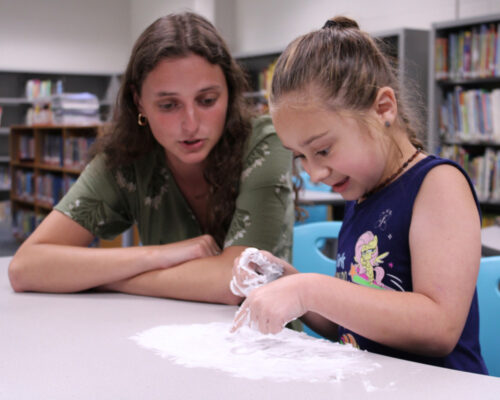
Throughout the school, graduate students worked with their assigned elementary students on different literacy skills. On the front sidewalk, chalk words lead the way through vowel sound hopscotch and other games. In the entranceway, students tossed a ball into paper targets to earn points for word identification. In the library, Juliet Frischmann, a Fourth Grade teacher at Brighton Central School District watched her student write spelling words in shaving cream spread across the tabletop.
“One hour and 15 minutes of one-on-one instruction every day is a lot of valuable instruction time,” said Frischmann. “We worked with the students on specific skills they need, either word work, writing, or reading, and it’s great for us as educators to practice our skills while motivating and engaging with the students.”
Peter Dyson, a Special Education Teacher in the Elmira City School District, sits nearby in the library with his student. “Because we did an assessment at the beginning and one at the end, we were able to make the instruction very specific to each student. And we are able to see improvement. For example, one student started the clinic not using punctuation or capitalization in their writing sample, but by the end, they were. So, there is a clear improvement there.”
“There are also practical application skills,” said Frischmann. “When the students open a book, instead of just looking at the pictures, they will try to sound out the words. These are skills they can take with them to use in the next year, and that is a big growth in itself.”
As the students were dismissed, many shared a hug or high-five with their teachers. “It really is a unique program,” said Brown. “The clinic allows educators to complete the hours needed for their degree programs and our students have access to high-quality one-on-one literacy instruction, which gives them the tools they will need to excel in the fall.”
Provided information