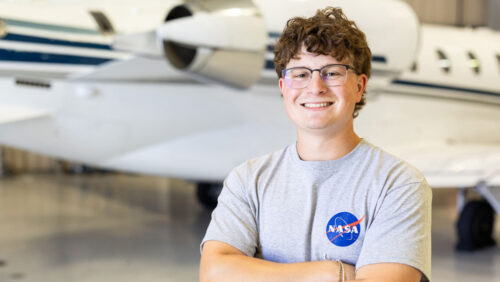
SUNY Brockport meteorology major Logan Jewell was one of 24 students nationwide selected to spend their summer flying with NASA pilots and conducting research in California as part of NASA’s Student Airborne Research Program (SARP).
“The first week is learning all about airborne research and why it is important. The second week we went on flights with NASA,” Jewell said. “It was amazing. We got to walk around the plane and look at the instruments monitoring the ozone and aerosol levels while they were in use.”
Jewell was selected for the West Coast research group located at the UC Irvine campus. SARP members were randomly assigned to one of four research groups: Whole Air Sampling, Atmospheric Aerosols, Ocean Remote Sensing, or Land Remote Sensing.
Once assigned a group, each student selected their own research project to pursue throughout the remainder of the program, culminating in a presentation to NASA researchers. Jewell was chosen for the Ocean Remote Sensing group.
“My project is based on natural oil seepage in the Santa Barbara Channel,” Jewell said. “There was an oil platform placed in the area to extract oil from the ground. The platform was decommissioned in 2015, and my research explores how the seepage responded after its removal.”
Jewell’s goal was to use satellite imaging to locate oil slicks—visible layers of oil that float on the ocean’s surface. When he initially inherited the project from a past SARP member, slicks were being identified manually by reviewing satellite images one at a time.
Jewell wanted to take a different approach—utilizing a machine learning algorithm to detect potential oil slicks automatically.
“I was able to create an algorithm that worked for certain images, but not all of them,” Jewell said. “For the ones it worked on, it had high accuracy. During my time I was able to classify 27 images using the model, more than double what had been done in the past.”
Prior to SARP, Jewell didn’t have any experience working with satellite imaging or machine learning—but that didn’t hinder his progress.
“I ended up using a random forest machine learning algorithm, which was something I had never done before,” Jewell said. “First, I researched how other scientists used it in the past for oil spills. Then, I shared the idea with my student mentor, who used the same algorithm on land, and she offered a lot of guidance.”
After working on the project for more than five weeks, Jewell gave a 12-minute presentation in front of NASA scientists.
“This was the first time I was able to present my findings and be confident in the work that I did,” Jewell said. “It was nerve-wracking. They asked some tough questions.”
Jewell first heard about SARP from SUNY Brockport alum Patricia Hutton ’23, who was part of the Aerosol’s group during her summer research experience with NASA. Growing up and attending college in upstate New York, Jewell was initially hesitant about applying to SARP and flying across the country to live on the West Coast for six weeks.
Jewell encourages other students to step outside their comfort zones—something he had to do himself when applying to the program.
“Sometimes you have to do something that scares you,” Jewell said. “I was worried about traveling to the other side of the country, but it was a fantastic opportunity. I made great friendships while I was there.”
Provided information and photo