By Kristina Gabalski
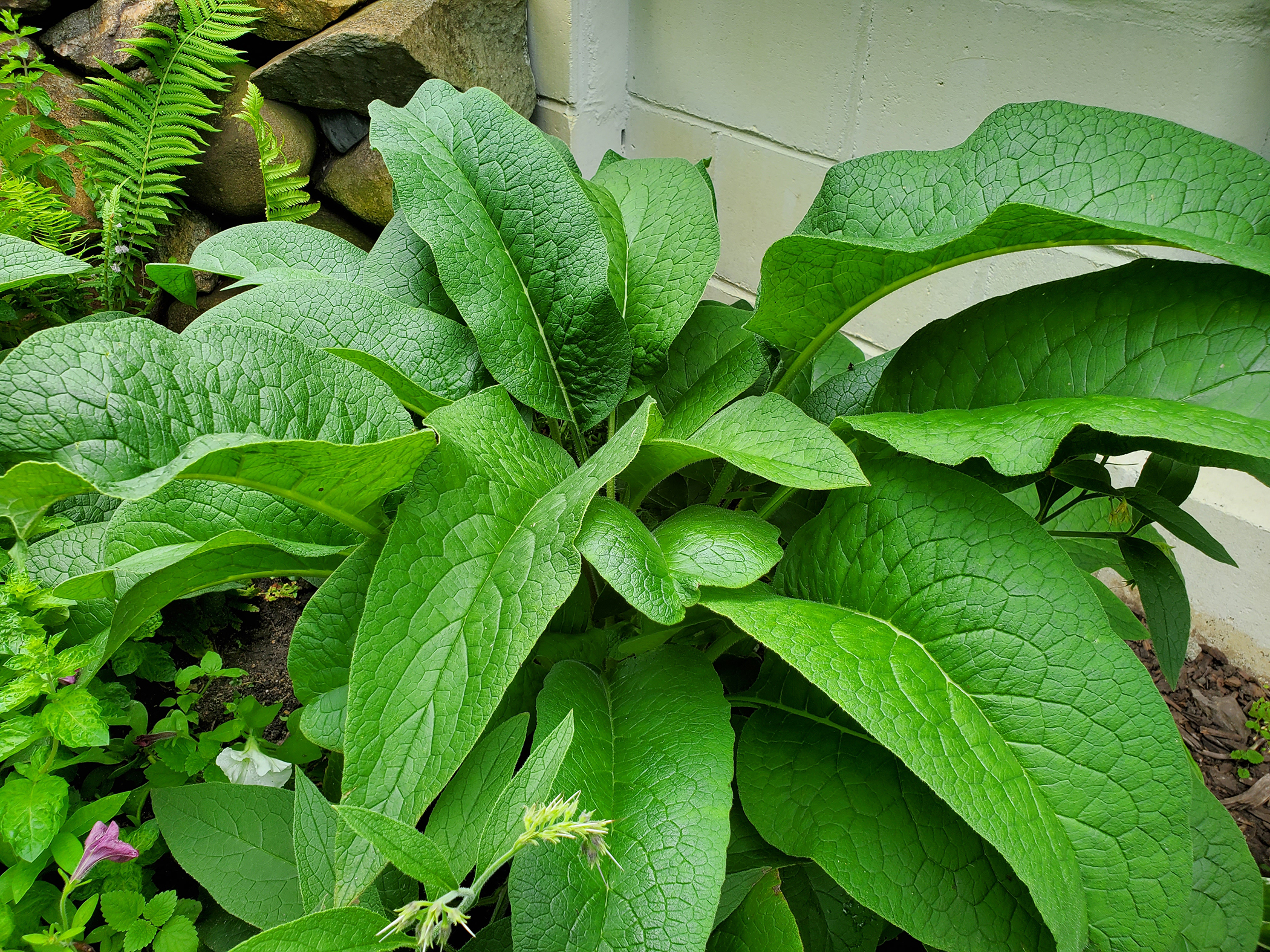
Herbs are interesting and beautiful plants, and comfrey (Symphytum officinale) is no exception. This hardy perennial is a member of the borage family. It has 12 to 18-inch-long leaves, which are somewhat hairy and can reach a height of over two feet and a spread of more than three feet. It is a medicinal herb used to treat and help heal bruises topically.
I had never seen comfrey growing in a garden until last summer, when I saw it mixed in a bed with annual flowers and other perennials. Its deep green, lush leaves made it stand out.
According to Utah State University Extension, comfrey likes partial sun and moist, fertile soil. The plant rarely produces seed (flowers are blue bells, which fade to pink), and so it must be cultivated by root cuttings or crown divisions. If you can’t find plants from local garden centers, they are available online. I have not yet tried growing comfrey myself, but Utah State University says it can be planted throughout the growing season. It establishes best when planted in the spring. Keep new plantings moist. Once established, the plant continues to prefer moderate soil moisture but develops a deep taproot and overall root system.
Comfrey is a very hardy plant, outcompeting weeds and having next to no disease or pest issues. There are two common varieties: common comfrey and Russian comfrey (Bocking No. 14, which is a narrow-leaved, fine-stem type). If you find comfrey at your local garden center, it is most likely the Russian variety.
Comfrey is adaptable but grows best in moist, fertile soil rich in organic matter with a pH of 6.0 to 7.0. Utah State University says that if you fertilize with compost, apply no more than one inch of well-composted organic matter over the planting area. Once plants are established, water when the top two inches of the soil are noticeably dry. Comfrey does need adequate nitrogen and requires nitrogen fertilization throughout the year. Utah State University recommends using around 1 to 2 teaspoons (21-0-0) per square foot per month.
In researching this column, I found mixed opinions on how aggressive comfrey can be in the garden. Some sources said it is a hardy, well-behaved plant, while others said it can become invasive if not contained or controlled.
If you plan to harvest comfrey for external use in poultices and compresses, wait until the second year after planting. You can harvest leaves every two weeks during the growing season by gathering a bunch and cutting two inches above the ground. To dry the leaves, lay them in a dry, open area for at least three days. The leaves have a high moisture content and can take longer than other herbs to dry. You can also consider freeze-drying, which is the quickest and best way to maintain high quality.
Comfrey is cold-hardy to zone four. Take note that comfrey contains toxic alkaloids, which, if ingested, can build up in the liver and cause permanent damage or even death in livestock and humans. External use only is recommended.
Interestingly, because comfrey has a high content of potassium and nitrogen, it can be used in the garden as a fertilizer or mulch. You can even add it to your compost pile to help kick the decomposition process into action.
Comfrey is an impressive plant in the garden. Photo by Kristina Gabalski.