By Kristina Gabalski
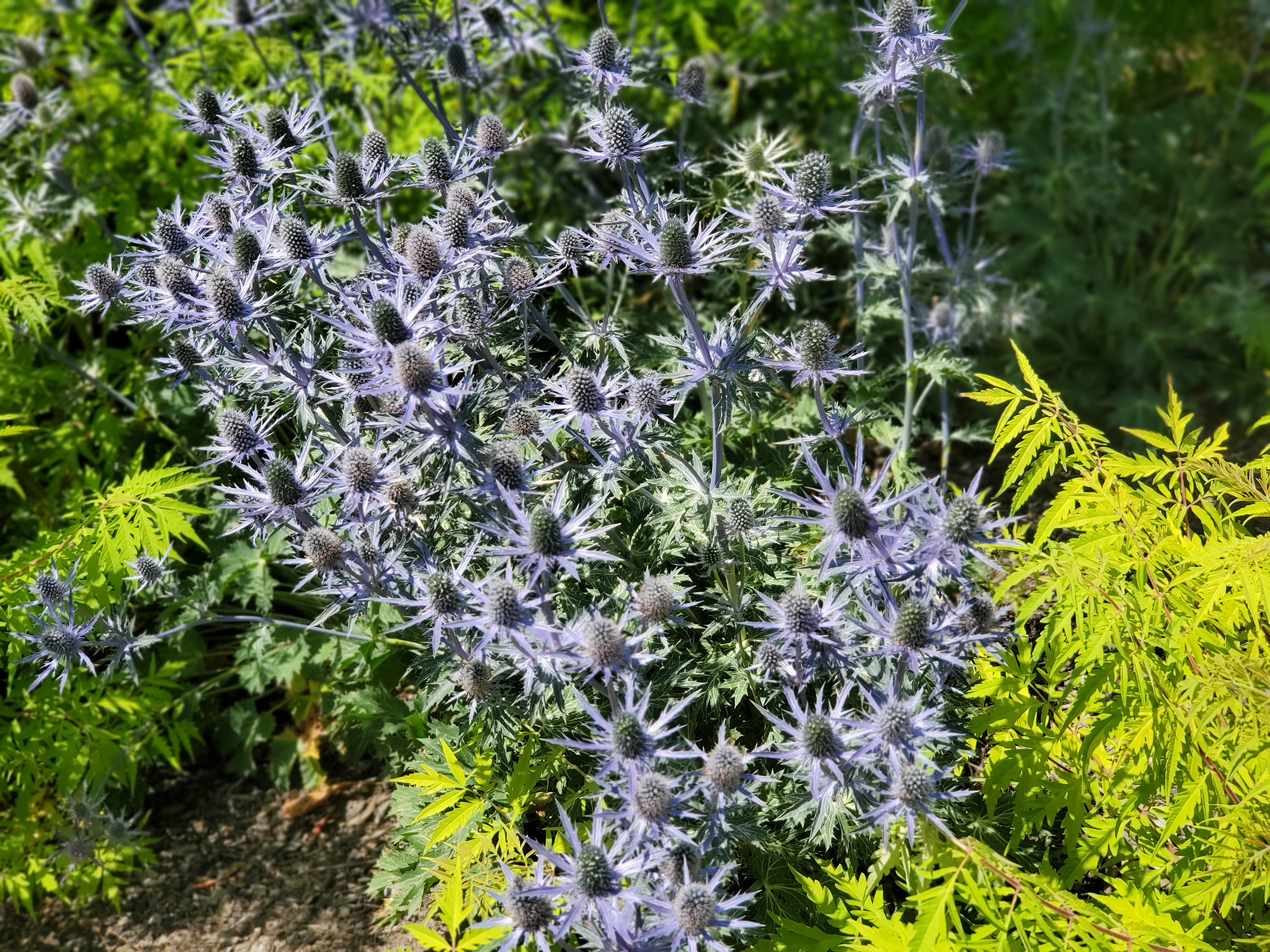
If you are looking for an interesting perennial flower to add to your landscape, look no further than Eryngium Planum, commonly called sea holly. This plant, with spherical-cylindrical umbel-shaped flower heads, has a prickly or spiny look that adds both texture and architectural interest to your garden.
The flower head contains tiny, stemless, violet-blue flowers and is subtended by a narrow, spiky collar of spiny, blue-green bracts. Yes, it is quite striking.
The Missouri Botanical Garden says the plant is an excellent selection for baked areas of the landscape. Sea holly needs a dry location as it is susceptible to root rot. It has few serious insect or disease problems, but can suffer from leaf spot diseases, aphids, slugs, or snails.
This plant will tolerate poor soils and has a taproot, which makes it challenging to transplant. Plants can spread in the garden once they are established. Because of this, experts say to site the plant carefully.
UT Gardens (The State Botanical Garden of Tennessee) notes that sea holly fits into every garden style from formal to wildflower to rock gardens. The plants are attractive to butterflies and other pollinators, and flowers can be harvested for bouquets.
According to Plantura Magazine, native species of Eryngium can be found on almost every continent. Top species include Blue eryngo (Eryngium planum), which is native from Central Europe to the Western Himalayas. Blue flower heads appear from the end of June to mid-August and are surrounded by grey-blue bracts. The flower heads are comparatively small.
Miss Willmott’s ghost (Eryngium giganteum) is native to the Caucasus, Turkey, and Iran. This variety naturally grows in gravel soils, making it a great choice for rock gardens. Miss Willmott’s ghost is biennial, with silvery bracts and white flowers, blooming from early June to the end of July.
Rattlesnake-master (Eryngium yuccifolium) is native to the central and eastern United States. If you are looking for natives local to our area, this fills the bill. These delicate plants form spherical, white-grey flower umbels in early July. Leaves are similar to the genus Yucca – hence the second half of its Latin name. This variety is easy to care for but can be “lazy” about flowering, Plantura Magazine says. Rattlesnake-master typically flowers every two years. It has very small bracts – the round flower umbels are prominent on this variety. Make sure you plant Rattlesnake-master in a sunny location, as it does not tolerate shade well.
Finally, Alpine eryngo (Eryngium alpinum) is native to the Alps and likes a moderate to good nitrogen supply. This sea holly is thistle-like and has intense blue flowers from July to August. Plantura says it is threatened with extinction in its native habitat. If you grow this variety, be aware it may be more difficult than other sea hollies. It likes a spot that is sunny and cool, a difficult combination to come by in the garden.
Photo: Eryngium is a striking and unusual flowering perennial for the garden. It adds interesting color and texture to contrast with other plants. Photo by Kristina Gabalski.