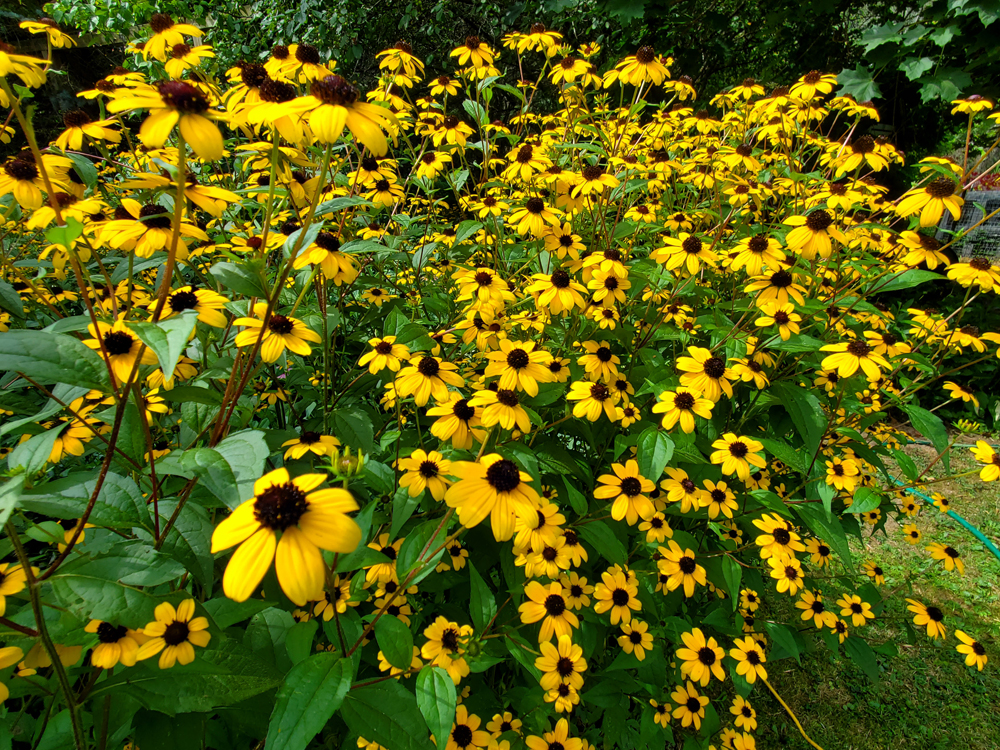
Rudbeckia triloba also known as branched coneflower, thin-leafed cornflower, and brown-eyed Susan, is a member of the aster family and is a very bright spot in the garden during late summer. It can reach up to five feet tall and is covered with small, golden blooms. This plant is a herbaceous biennial or a short-lived perennial and is native from New York to Florida, west to Minnesota, Utah, and Texas.
Wisconsin Extension Horticulture says it is naturalized in open woods, old fields, and rocky slopes.
The dark green basal leaves have a hairy texture and are divided into three oval parts. The plant has similarities to black-eyed Susan (R. hirta), but it is taller and has much smaller blossoms. It also has a longer blooming period.
Wisconsin Extension Horticulture notes that brown-eyed Susan can create a stand-out display at this time of year with its masses of yellow flowers. The blooms are flat with button-shaped black centers that fade to brown.
The ray of petals is shorter and wider than other coneflowers. Flowers are produced at the end of multi-branched stems.
Wisconsin Extension Horticulture recommends brown-eyed Susan for mass plantings in the perennial border. I find it makes a charming back-of-the-border plant with its airy habit and abundant blooms. Try it in informal, naturalized garden settings.
Brown-eyed Susan may need staking. Wind and rain can knock down stems once it reaches full bloom.
It can be used as a cut flower and I love how it looks in bouquets with zinnias and dahlias, but beware; even with conditioning, some stems can flop unexpectedly while others hold up well for days. I find harvesting early in the morning and placing stems in water immediately can help.
Plant them in full sun or light shade. Brown-eyed Susan is not terribly picky about soil, and I have some that are doing well in shady areas, but it does like moderate moisture to look its best. Wisconsin Extension Horticulture says the plant is drought tolerant once established, but I have found that the lower leaves die back in extended dry weather like the weather we have been having this summer. They can also droop in the hot, mid-day sun. I have resorted this year to watering them to keep them looking good and to help them hold up after harvest in bouquets.
Brown-eyed Susan is a short-lived perennial, but readily self-sows and can even be quite aggressive. I know gardeners who do not grow brown-eyed Susan because of this trait, but I find it will grow in places other plants will not, and it adds so much interest at this time of year. I collect seed heads to scatter around the garden. You can always pull out plants you don’t want. The plants can look tired after flowering – cut them back if desired, but if you want them to self-sow, leave some mature seeds in the garden.